Sony Expands XYN Spatial Capture With Object Scanning, 3D Reconstruction and New Creator Plans
Sony expands XYN Spatial Capture with object scanning, 3D reconstruction, Unreal Engine rendering and new subscription plans for creators and studios in the United States and Canada.
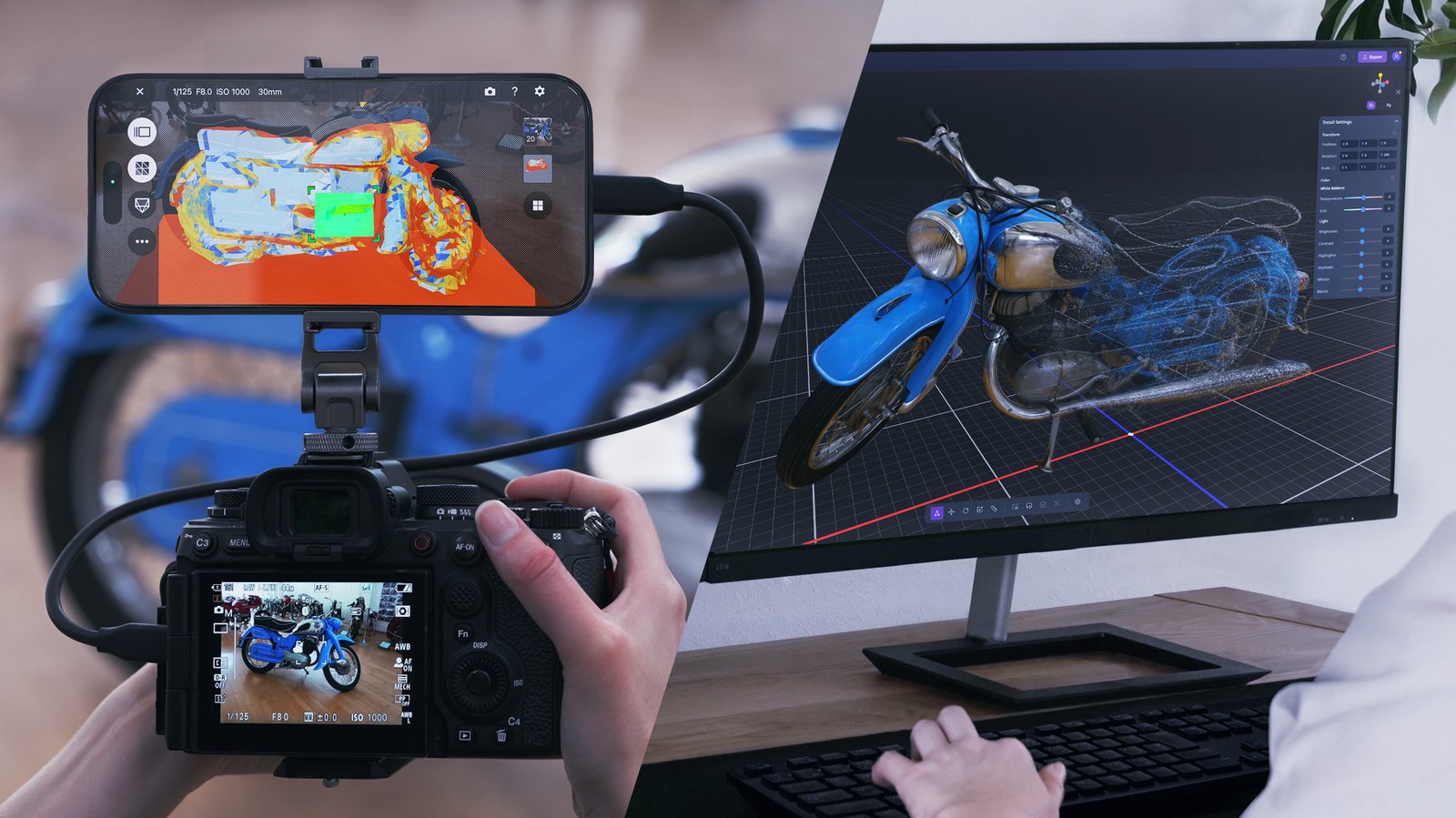
Image: Sony Electronics / Sony XYN. Official manufacturer promotional image showing the capture and reconstruction workflow.
Key takeaways
- Sony announced the XYN expansion on October 27, 2026; its English XYN website update followed on October 28. The service is commercially available in the United States and Canada.
- Object scanning connects AR-guided capture, cloud reconstruction through the XYN Venus Algorithm and rendering in production environments.
- Updated Unreal Engine tools and Aximmetry support broaden the virtual-production workflow; visually realistic assets are not automatically engineering-grade digital twins.
- US monthly plans range from $0 to $209.05 before tax; included generation tokens vary by plan and expire six months after being granted.
- Experimental XYN Lab applications are planned before the end of 2026 and should not be confused with currently available commercial features.
On this page
Turning physical environments into digital assets
Creating realistic three-dimensional environments remains an important part of immersive content production.
Virtual reality applications, digital twins, games and virtual production environments frequently require detailed representations of physical spaces.
Traditionally, these assets have been created through manual modeling, photogrammetry or specialized scanning equipment.
Each approach introduces different requirements involving equipment, software and production time.
On October 27, 2026, Sony announced an expansion of its XYN Spatial Capture solution.
The platform is now commercially available in the United States and Canada through new subscription plans and online purchasing options.
The update also introduces additional object-scanning capabilities and improvements to the software used to capture, generate and render three-dimensional assets.
The development expands the platform beyond its original emphasis on virtual production backgrounds.
Sony is now positioning XYN for a wider range of applications, including product visualization, gaming, digital twins and immersive experiences.
What is Sony XYN?
XYN is Sony's ecosystem for spatial content creation.
The platform combines capture guidance, cloud-based reconstruction and rendering software.
Its purpose is to help creators transform real-world environments into digital assets that can be used within three-dimensional production workflows.
The Spatial Capture solution consists of three principal applications.
XYN Spatial Scan Navi assists users during image capture.
XYN Spatial Scan processes captured information and generates 3D assets.
XYN Spatial Renderer Plugin displays the generated assets within compatible rendering and production environments.
The applications perform different tasks but are designed to operate within a connected workflow.
A creator can capture an object or environment, process the images and use the resulting asset in a virtual scene.
Sony originally announced the solution in April 2026.
The October update expands its functionality and makes the service available through a broader commercial model.
Capturing objects as well as environments
One of the principal additions is support for generating three-dimensional assets from individual objects.
Earlier XYN workflows emphasized larger environments and backgrounds.
The updated system can now process subjects such as props, consumer products, vehicles and industrial objects.
This expands the range of potential applications.
A film production team could capture a physical prop for use in a virtual environment.
A product designer could create a digital representation of an existing object.
A game developer could incorporate captured assets into a three-dimensional scene.
Industrial teams could use reconstructed equipment as visual references.
Sony's reconstruction system is designed to preserve visual characteristics such as material appearance, transparency and reflective surfaces.
However, photorealistic reconstruction should not automatically be interpreted as engineering-grade measurement.
A visually accurate asset may still require additional processing or validation before being used in applications requiring precise dimensions or physical simulation.
The update primarily addresses the generation of realistic visual assets.
The XYN Venus Algorithm
At the center of the reconstruction workflow is Sony's proprietary XYN Venus Algorithm.
The algorithm processes captured images to generate three-dimensional computer graphics assets.
With the October update, users can specify the region of an object they want to reconstruct.
This provides greater control over the generated result.
The system also allows creators to configure parameters related to output quality and color workflows.
These options are relevant because different production environments require different types of assets.
A real-time game may prioritize rendering performance.
A virtual production environment may require detailed visual quality.
A product visualization workflow may emphasize material appearance.
The ability to configure reconstruction parameters allows creators to adapt the output to their intended use.
Sony also supports HDR-oriented workflows and color management for compatible production environments.
The company has not presented the update as a replacement for every conventional 3D modeling or scanning technique.
Instead, it is designed to simplify specific stages of photorealistic asset creation.
Spatial Scan Navi guides the capture process
Capturing enough visual information is essential for successful reconstruction.
If an object is photographed from too few angles, important surfaces may be missing.
Inconsistent camera distances can also complicate reconstruction.
XYN Spatial Scan Navi addresses these problems through guided capture.
The smartphone application works with compatible Sony Alpha mirrorless cameras.
It uses augmented-reality guidance to help users determine where to position the camera.
The October update introduces Object: Assist Mode.
This feature is designed specifically for capturing individual objects.
The application adjusts its guidance according to the size of the subject.
It helps users maintain an appropriate distance while moving around the object.
The objective is to capture the object from enough perspectives to support reconstruction.
The application therefore uses spatial guidance as part of the content-creation process.
Rather than simply recording photographs, it provides information about how those photographs should be captured.
Sony lists compatibility with selected iPhone Pro models, including supported iPhone 15, 16 and 17 Pro variants.
The complete workflow also depends on compatible camera equipment and software configurations.
Cloud reconstruction simplifies asset generation
Once the capture process is complete, the images can be processed through XYN Spatial Scan.
This cloud-based application generates the three-dimensional asset.
The workflow separates image acquisition from computationally intensive reconstruction.
Users do not necessarily need to perform the entire generation process on their local computers.
Instead, processing takes place through Sony's service.
This approach can simplify access to reconstruction capabilities, particularly for smaller teams.
However, cloud processing introduces considerations involving upload time, connectivity, storage and service costs.
The amount of information captured can vary significantly depending on the subject.
A small object requires a different capture process from a large industrial environment.
The resulting assets may also require optimization before being incorporated into real-time applications.
XYN is intended to streamline the generation stage, not eliminate every subsequent production task.
Improved rendering in Unreal Engine
Another part of the update concerns the XYN Spatial Renderer Plugin.
The plugin allows generated assets to be displayed within compatible production environments.
Sony has introduced improvements for rendering workflows using Unreal Engine.
These include capabilities for editing splat-based representations, processing visual data and reducing flicker.
Flickering can become noticeable when detailed reconstructed content is displayed across changing viewpoints or lighting conditions.
Reducing these artifacts can improve the visual consistency of generated scenes.
The plugin is designed for production environments where image quality is important.
This includes virtual production stages using LED walls or green screens.
The updated software also expands integration with external production tools.
In addition to Unreal Engine and Disguise RendererStream, Sony has introduced support for Aximmetry's virtual production platform.
These integrations allow generated assets to become part of broader content-production workflows.
From physical capture to virtual production
Virtual production combines real-world filming with digitally generated environments.
Instead of creating every background physically, production teams can display digital environments on LED walls or integrate them during compositing.
Spatial capture can provide realistic representations of existing locations.
For example, a production team might capture a building that is difficult to access repeatedly.
The reconstructed environment could then be used as a background during later filming.
This can reduce the need to recreate the location manually.
It may also allow teams to maintain visual continuity when returning to a project.
However, successful virtual production still requires camera tracking, lighting coordination, color management and other production processes.
A reconstructed environment is one component of the workflow.
XYN's updated rendering capabilities are intended to help integrate that component into established production systems.
Applications beyond entertainment
Although XYN has strong connections to film and virtual production, Sony identifies several additional application areas.
- Gaming: Real-world objects can be reconstructed and adapted for use in interactive environments.
- Product visualization: Physical products can become digital assets for presentations, visualization and design workflows.
- Digital twins: Captured environments can provide a visual representation of existing facilities or equipment.
- Architecture: Buildings and spaces can be reconstructed for documentation and visualization.
- Cultural heritage: Physical locations and objects can be digitally preserved.
These applications share a common requirement: converting information from the physical world into reusable digital content.
However, the requirements differ.
A game may need optimized geometry and collision information.
A digital twin may require structured operational data.
An architectural workflow may need verified dimensions.
XYN's photorealistic reconstruction capabilities provide a starting point, but additional tools may be necessary for each application.
New subscription plans
Sony has introduced a subscription model designed for different production scales.
The company now offers four principal plans in the United States.
The following US prices are monthly subscription prices, excluding tax; they are not Sony’s discounted six-month contract prices.
- Free: $0.00 per month, excluding tax; 0 generation tokens included.
- Creation 500: $20.00 per month, excluding tax; 500 generation tokens included.
- Creation 2000: $67.32 per month, excluding tax; 2,000 generation tokens included.
- Creation 2000 + Renderer: $209.05 per month, excluding tax; 2,000 generation tokens included.
The free plan allows users to explore the workflow and purchase generation tokens separately.
Paid plans include monthly token allocations.
The highest-priced plan also provides the commercial version of the XYN Spatial Renderer Plugin.
The other plans include access to a trial edition of the renderer.
Sony also offers additional token purchases.
The token system is important because the monthly subscription price does not necessarily represent the total cost of producing an unlimited number of assets.
Asset generation consumes tokens.
The actual cost of a project depends on the amount of processing required and the available token allocation.
Sony states that tokens expire 6 months after being granted.
The company has also introduced online credit card purchasing, reducing the need for a traditional enterprise procurement process for smaller customers.
A workflow designed for different production scales
The new commercial structure reflects the different requirements of spatial content creators.
A freelance professional may need to capture only a few objects each month.
A small studio may produce assets regularly.
A larger production company may require continuous reconstruction and rendering capabilities.
These users do not necessarily need identical software packages.
The subscription model separates access to the core tools from the amount of generation capacity included.
This allows customers to select a plan according to expected production volume.
However, teams evaluating the platform should consider more than the monthly subscription.
Relevant factors include capture equipment, cloud processing, storage, export requirements and compatibility with existing production tools.
The complete workflow determines the practical cost of creating reusable spatial assets.
Sony plans experimental Lab applications
Sony has also announced plans to introduce experimental applications within the XYN ecosystem.
The initiative is expected to begin rolling out before the end of 2026.
These Lab applications will allow creators to test features and algorithms that remain under development.
The objective is to collect feedback before incorporating selected capabilities into broader product releases.
This introduces a more iterative approach to developing the platform.
However, the Lab applications are future plans.
They should not be presented as part of the currently available commercial feature set.
Their functionality and release schedule may change during development.
Spatial content creation is becoming more accessible
The XYN update illustrates how spatial content creation is evolving.
Historically, producing detailed three-dimensional representations of real-world environments often required specialized equipment and substantial technical expertise.
Modern reconstruction systems are reducing some of those barriers.
Guided capture can help users collect suitable information.
Cloud processing can handle computationally demanding reconstruction.
Rendering plugins can integrate generated assets into established production tools.
Together, these components create a more connected workflow.
The availability of subscription plans also changes how creators can access the technology.
Instead of requiring a large initial software investment, users can select different levels of processing capacity.
The approach does not eliminate the need for technical knowledge.
High-quality spatial content still depends on capture conditions, reconstruction quality and the requirements of the final application.
Nevertheless, the platform provides another example of how spatial content creation is moving toward more accessible software services.
From capturing spaces to building reusable digital environments
Sony's October 2026 update expands XYN in two important directions.
First, the platform can now generate assets from a wider range of physical subjects.
Second, its commercial model supports creators and organizations with different production requirements.
The addition of object scanning is particularly relevant.
It allows the same general workflow to support both environments and individual assets.
The improvements to Unreal Engine rendering and virtual production integrations extend how those assets can be used.
The result is a platform that connects several stages of spatial content creation.
Physical information is captured.
The data is processed into a digital representation.
The resulting asset is prepared for visualization and production.
Sony XYN reflects a broader transition in spatial computing: from manually building every digital environment toward capturing, reconstructing and reusing information from the physical world.
Sources
- Sony Electronics — Official announcement, October 27, 2026: sony.mediaroom.com/2026-10-27-XYN-TM-Spatia…
- Sony XYN — English product update, October 28, 2026: xyn.sony.net/en/news/news/2026-spatia…
- Sony XYN — Official monthly US subscription pricing, checked November 3, 2026: xyn.sony.net/en/pricing
- Sony XYN — Token validity and usage FAQ: xyn.sony.net/en/support/accounts-and-…
- Sony XYN — Product ecosystem and documentation: xyn.sony.net/en
Coverage of industry news across spatial computing and immersive technologies. Product details come from manufacturers' public documentation, sources are linked at the end of each article, and a person reviews every article before publication.
Related reading

VeriSilicon Introduces Nano-XR Technology to Reduce Power Consumption in AI and AR Glasses
VeriSilicon has announced a wearable computing subsystem designed specifically for AI and augmented reality glasses. Its Nano-XR technology combines specialized processing components with an optimized architecture intended to reduce energy consumption, memory requirements and processing latency.

GTA 6 and Virtual Reality: What XR Headsets Can Actually Deliver Today
Following the release of Grand Theft Auto VI, questions have emerged about compatibility with virtual reality headsets. Current options involve displaying the console game on a virtual screen rather than entering its world through a native immersive VR experience.
ArcGIS XR Viewer Adds Gaussian Splatting, AI Voice Controls and Collaborative 3D Tools
Esri updates ArcGIS XR Viewer with Gaussian Splatting, AI voice commands, BIM exploration and collaborative 3D sketching for immersive geospatial workflows.