VeriSilicon Introduces Nano-XR Technology to Reduce Power Consumption in AI and AR Glasses
VeriSilicon has announced a wearable computing subsystem designed specifically for AI and augmented reality glasses. Its Nano-XR technology combines specialized processing components with an optimized architecture intended to reduce energy consumption, memory requirements and processing latency.
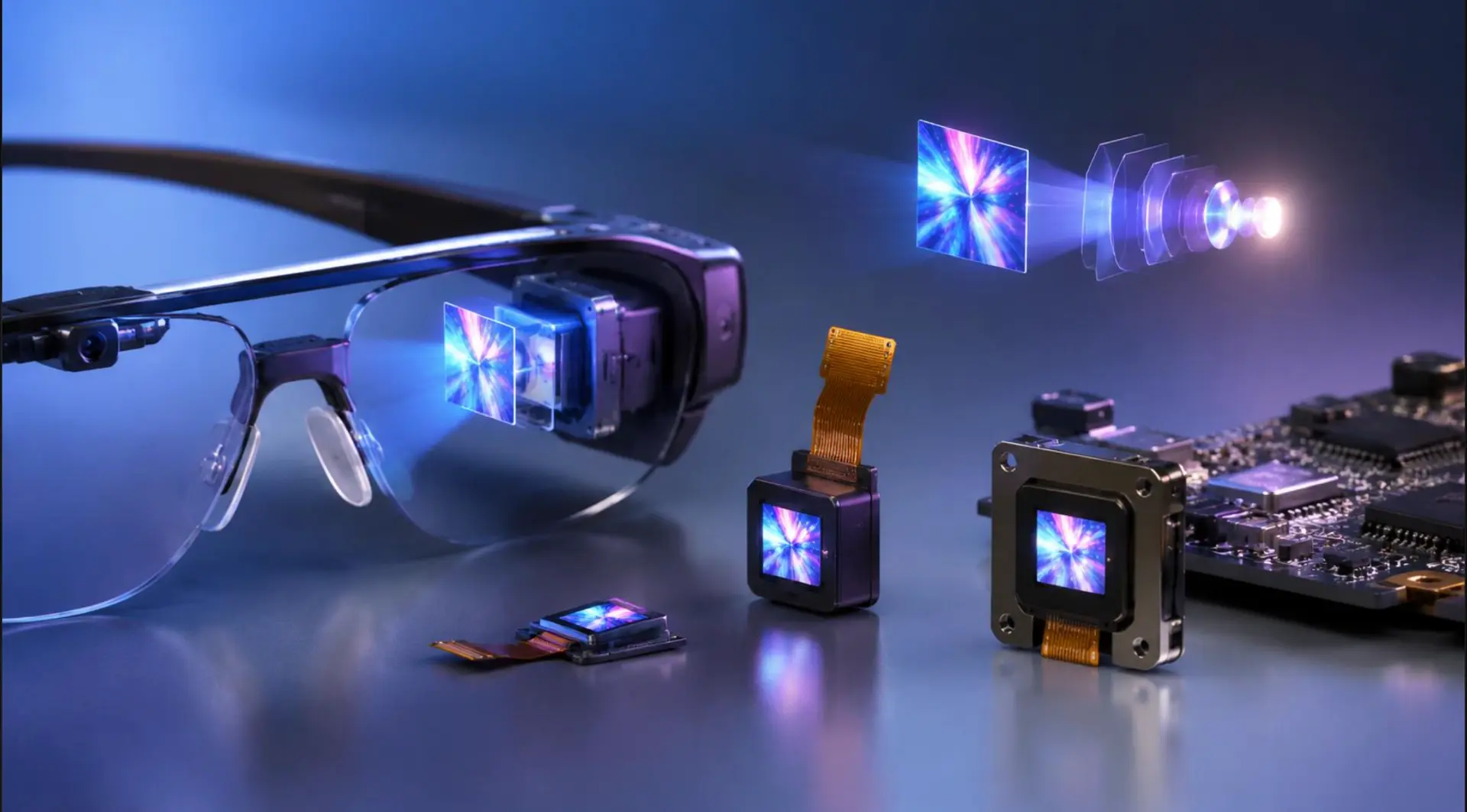
Illustrative visual supplied with the article; not an official photograph of Nano-XR hardware.
Key takeaways
- VeriSilicon announced its Nano-XR wearable subsystem on November 18, 2026 for next-generation AI and augmented reality glasses.
- The four Nano-XR IP components cover image processing, infrared sensing, low-latency display processing and graphics rendering.
- FLEXA and DECNano target data movement, external-memory bandwidth and capacity requirements rather than raw processor performance alone.
- These are semiconductor IP components for manufacturers to integrate into custom hardware, not standalone consumer processors or finished glasses.
- No independent device-level benchmarks or confirmed consumer product launch yet establish the technology's effect on battery life, thermals or weight.
On this page
The engineering challenge behind smaller smart glasses
Making smart glasses smaller involves more than reducing the size of their frames. Cameras, displays, tracking sensors and AI processors must operate within strict physical and thermal constraints.
On November 18, 2026, semiconductor technology provider VeriSilicon announced a wearable subsystem designed to address these requirements. The announcement introduces its Nano-XR intellectual property portfolio alongside technologies for optimizing communication between processing components.
The technology targets manufacturers developing different categories of intelligent eyewear, from relatively simple camera-equipped devices to more advanced augmented reality systems.
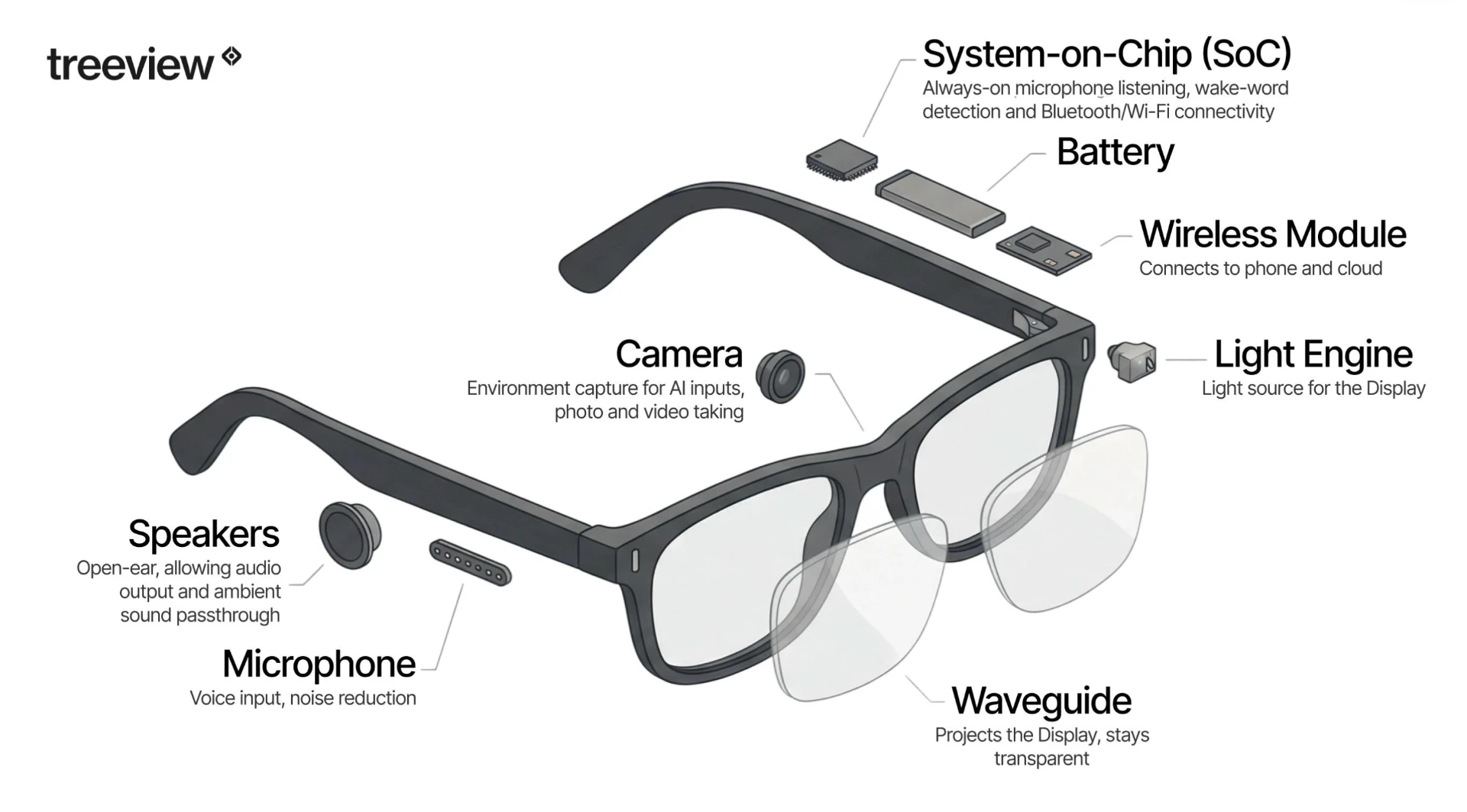
Specialized processing instead of a single computing workload
Smart glasses do not perform one continuous computing task. They alternate between workloads with very different processing requirements.
Detecting a voice command, interpreting camera input, recognizing a hand gesture and rendering a spatial interface each require different computational resources.
A heterogeneous architecture allows these tasks to be distributed across specialized processing components.
For example, a lightweight sensor-processing system can monitor incoming signals without requiring a more powerful graphics processor to remain active continuously.
This approach is particularly relevant to wearable devices, where energy consumption influences both battery autonomy and the amount of heat generated near the user's face.
Four components designed for XR workloads
VeriSilicon's Nano-XR portfolio introduces four specialized technologies.
- ISPNanoUltra-XR: Image processing optimized for wearable photography and video.
- ISPPico-XR: Infrared sensor processing for functions including gaze and gesture detection.
- DCNanoUltra-XR: Display processing designed for low-latency spatial applications.
- GCNanoOptimaV-XR: Graphics processing with projection transformations and reduced memory requirements.
These are semiconductor IP components that manufacturers can incorporate into custom hardware designs, rather than four standalone consumer processors.
Why moving data consumes energy
Computational efficiency is not determined exclusively by processor performance.
Moving information between sensors, processors and memory also consumes energy.
Consider an AR application that uses a camera to understand its surroundings. Captured images may pass through several processing stages before the system generates a response.
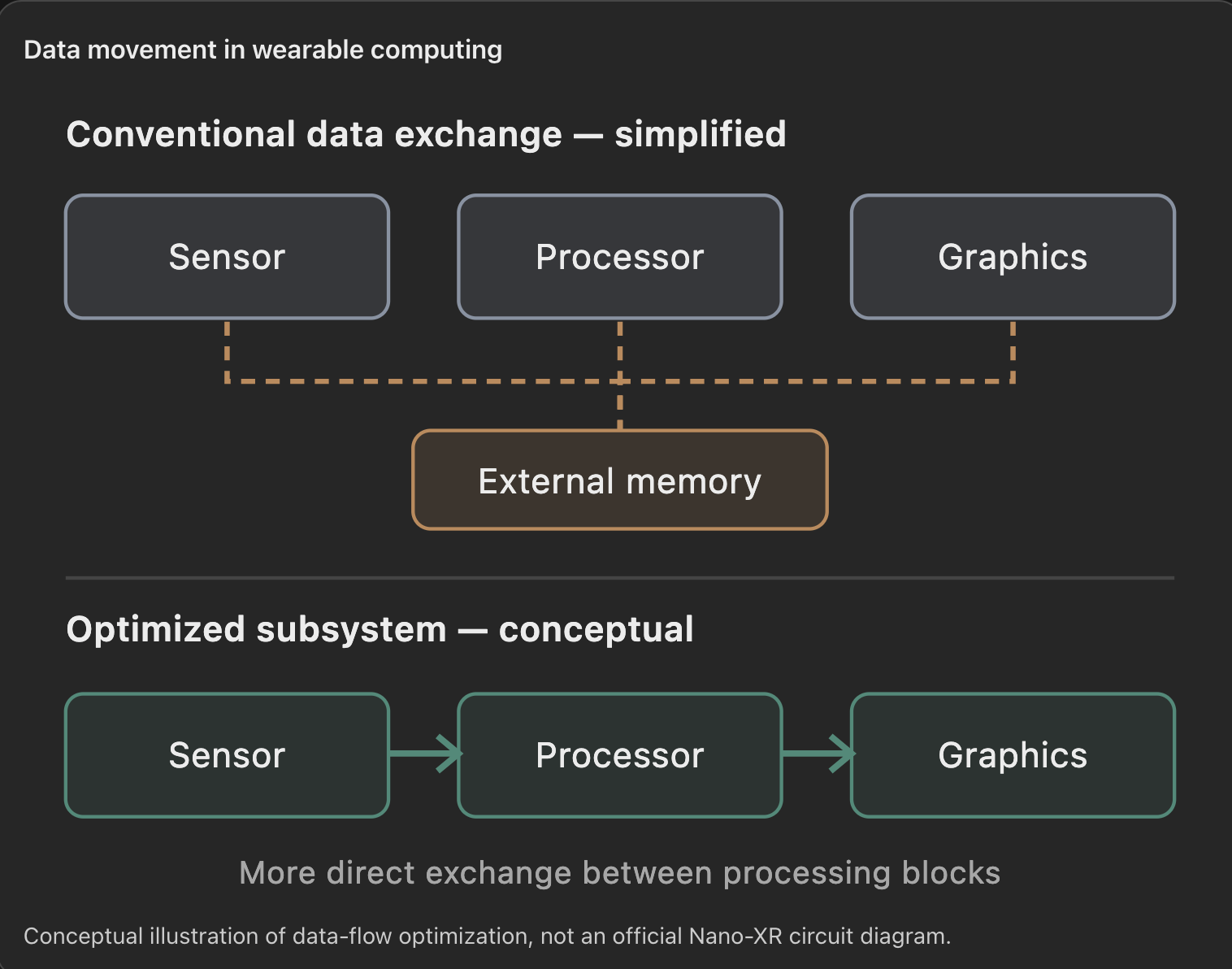
If every intermediate result must be written to external memory and subsequently retrieved, the system performs additional operations that consume power and introduce latency.
Reducing unnecessary data movement can therefore improve the efficiency of the overall architecture, even without increasing raw computing performance.
FLEXA and DECNano address memory efficiency
Two additional technologies form part of VeriSilicon's subsystem approach.
FLEXA facilitates communication between processing blocks using intermediate on-chip storage. DECNano compresses visual data to reduce external memory bandwidth and capacity requirements.
VeriSilicon describes these technologies as mechanisms for improving subsystem efficiency.
The practical benefit depends on how manufacturers integrate the components, which workloads they prioritize and the final semiconductor implementation.
Eye tracking and always-on sensing
Eye tracking presents a particularly interesting engineering challenge for lightweight XR devices.
A gaze-tracking system may need to collect information continuously while the user interacts with an interface.
Unlike occasional photography, this creates a sustained processing workload.
The same applies to gesture recognition, environmental sensing and other contextual interaction mechanisms.
Dedicated low-power processing can help separate these background activities from more computationally demanding tasks.
In future AR glasses, this architectural distinction could influence how frequently tracking systems operate and which capabilities remain available throughout a session.
Implications for spatial rendering
Rendering digital content in augmented reality requires more than producing an image.
The system must account for the relationship between the display, the user's movement and the position of digital objects.
Processing delays can introduce visible inconsistencies between physical movement and displayed content.
Hardware designed around spatial workloads can help manufacturers address these requirements.
However, display processing is only one part of the latency chain. Sensor acquisition, tracking algorithms, application logic and optical hardware also contribute to the final experience.
Potential applications
- AI smart glasses: Camera input, voice assistance and contextual recognition.
- Enterprise AR: Hands-free instructions, equipment inspection and spatial information.
- Spatial navigation: Visual guidance and motion-aware information.
- Advanced interaction: Continuous gaze sensing and gesture-based controls.
What remains unconfirmed
The announcement concerns an underlying technology platform, not a finished pair of smart glasses.
VeriSilicon has not provided independent device-level benchmarks demonstrating how much battery life improves when manufacturers adopt the complete subsystem.
There is also no confirmed consumer product launch associated with the announcement.
Claims about longer battery life, improved thermal performance or reduced device weight will require evaluation in finished hardware.
The next generation of XR depends on its internal architecture
The development of smaller augmented reality devices requires progress across optics, batteries, sensors, processors and software.
Improving the efficiency of individual components is important, but optimizing how those components communicate can be equally significant.
VeriSilicon's Nano-XR announcement addresses this less visible layer of wearable computing.
Its eventual impact will depend on adoption by semiconductor manufacturers and the performance of commercial devices incorporating the technology.
Sources
- VeriSilicon — Official announcement, November 18, 2026. VeriSilicon Introduces Low-Power, High-Performance Wearable Subsystem Solution for Next-Generation AI/AR Glasses. Primary source. Performance objectives are manufacturer claims rather than independently validated device measurements.
Coverage of industry news across spatial computing and immersive technologies. Product details come from manufacturers' public documentation, sources are linked at the end of each article, and a person reviews every article before publication.
Related reading

GTA 6 and Virtual Reality: What XR Headsets Can Actually Deliver Today
Following the release of Grand Theft Auto VI, questions have emerged about compatibility with virtual reality headsets. Current options involve displaying the console game on a virtual screen rather than entering its world through a native immersive VR experience.

ArcGIS XR Viewer Adds Gaussian Splatting, AI Voice Controls and Collaborative 3D Tools
Esri updates ArcGIS XR Viewer with Gaussian Splatting, AI voice commands, BIM exploration and collaborative 3D sketching for immersive geospatial workflows.
Samsung and Google Reveal Intelligent Eyewear: Gemini Smart Glasses Starting at $395
Samsung and Google reveal Gemini-powered smart glasses starting at $395, with a 12MP camera, nine-hour battery life and December 10 availability.