Meta Connect 2026 puts AI glasses, VR and the next generation of XR development in focus
Meta Connect 2026 takes place September 23–24 with AI glasses, VR, Meta Horizon and AI technologies at the center of the event. Beyond potential hardware announcements, Meta is also preparing developers for new ways to build software across wearables and immersive environments.
Key takeaways
- Meta Connect 2026 runs September 23–24, with the main keynote followed by developer-focused sessions and an online stream.
- Meta is positioning AI glasses as a software platform spanning Android, iOS and web experiences rather than a closed accessory.
- The experimental Meta XR Operator gives AI agents spatial context and interaction capabilities inside running Unity XR applications through OpenXR and MCP.
- Reported hardware previews remain unconfirmed until Meta's keynote; the official agenda centers on AI, glasses, VR and Meta Horizon.
Meta Connect returns September 23–24
Meta Connect 2026 arrives this week with a noticeably different emphasis from previous editions.
The official event description places AI technologies and AI glasses alongside VR, while Meta's developer program adds Meta Horizon, SDK updates and new development workflows to the agenda.
The event takes place on September 23 and 24, 2026, with the main keynote on Wednesday followed by the Developer State of the Union and technical sessions on Thursday. Meta will stream the event online.
For the XR industry, the significance is broader than another hardware presentation. Meta is increasingly connecting three areas that previously operated more independently: AI, wearable computing and immersive computing.
AI glasses are becoming a development platform
One of the most important changes ahead of Connect is already visible in Meta's developer ecosystem.
Meta now describes its wearables platform as an environment where developers can build hands-free experiences for AI glasses and the Meta Neural Band. The available development paths include Android, iOS and web applications.
More significantly, Meta says developers can access camera, audio and display capabilities, allowing existing mobile applications to extend functionality into glasses or enabling standalone web experiences designed specifically for wearable displays.
This moves smart glasses beyond the traditional model of a closed hardware product with a predefined collection of features. They begin to look more like a software platform.
Display and gesture interaction are becoming part of the equation
Meta's current developer documentation also explicitly connects glasses with the Meta Neural Band, its wrist-worn EMG interface. Developers can create experiences where information appears on the glasses' display while interactions are controlled through gestures detected at the wrist.
That combination introduces an increasingly important question for spatial computing: what replaces the touchscreen when computing moves from phones to glasses?
- Voice offers direct, hands-free commands and conversational assistance.
- Hand tracking can translate movement into spatial input.
- Eye tracking, physical controls and neural interfaces provide additional interaction paths.
Meta's current direction suggests future wearable interfaces may combine several of these interaction methods rather than depend on a single input system.
VR remains a major part of Connect
The growing emphasis on glasses does not mean Meta is moving away from VR. Its official Horizon developer portal describes Connect 2026 as an opportunity to learn about agentic development workflows, SDK updates and the roadmap for immersive development.
Meta continues to support Unity, Unreal Engine, native development and OpenXR across its VR ecosystem. There is also a new technical development that could become particularly relevant to XR developers: Meta XR Operator.
Updated on September 9, XR Operator is an experimental OpenXR API layer that allows AI agents to obtain spatial context from and interact with a running Unity XR application.
The system sits between the XR application and the OpenXR runtime, exposing session state, tracking data and input control through the Model Context Protocol. In practical terms, an AI agent can potentially observe what is happening inside an XR application and interact with it during development and testing.
Meta currently labels the technology experimental and explicitly warns developers not to depend on it for production applications.
AI is moving inside the spatial development workflow
XR Operator illustrates a broader change occurring around immersive software. AI is no longer limited to generating code outside the experience.
An agent with access to spatial context could potentially inspect an XR scene, understand runtime behavior, execute interactions and help identify problems directly within an immersive application.
This creates a different development model from traditional automated testing. XR applications contain information that conventional software testing does not normally need to understand: head position, controller or hand input, spatial relationships, tracking state and movement through three-dimensional environments.
Giving AI agents access to those signals creates the foundation for more spatially aware development tools.
Hardware expectations remain high, but not everything is confirmed
As with every major Connect event, several hardware reports are circulating ahead of the keynote.
Recent reporting indicates that Meta may present additional smart-glasses hardware, including a camera-free model, while reports have also pointed to a possible demonstration involving Meta's next-generation lightweight mixed-reality research hardware and Codec Avatars. These details should currently be treated as reported rather than confirmed.
Meta's official communication is considerably narrower: Connect will cover its latest work across AI technologies, AI glasses, VR and Meta Horizon.
The distinction matters because Connect has historically included both products approaching commercialization and longer-term research. The keynote on September 23 will establish which of the current reports translate into actual announcements.
The boundaries between XR, wearables and AI are disappearing
Perhaps the most relevant aspect of Connect 2026 is therefore not a specific rumored device. It is the architecture beginning to form around these devices.
On one side are VR and mixed-reality systems capable of understanding a three-dimensional environment. On another are increasingly lightweight glasses capable of bringing digital information into everyday contexts. Across both is AI, moving from conversational assistance toward agents capable of understanding applications, environments and user context.
Meta's own developer ecosystem now reflects that convergence. Wearables have development toolkits. Displays can be controlled through EMG gestures. OpenXR applications can expose spatial information to AI agents. VR remains an immersive computing platform while glasses move closer to becoming an everyday computing interface.
Meta Connect 2026 arrives at a point where these previously separate technologies are beginning to become parts of the same computing stack. The announcements on September 23–24 should provide a clearer picture of how quickly Meta intends to bring those pieces together.
Sources
- Meta for Developers — Meta Connect 2026: official dates and coverage of VR, AI glasses, Meta Horizon and AI technologies
- Meta — Emerging Technologies: official event page and livestream registration for September 23–24
- Meta for Developers — Wearables: developer tools for AI glasses, displays and Meta Neural Band
- Meta Horizon Developers — XR Operator: experimental OpenXR and MCP documentation for spatial AI agents
- UploadVR — Project Phoenix report: unconfirmed pre-keynote reporting on possible hardware and Codec Avatars demonstrations
Editorial coverage of industry news and developments across spatial computing and immersive technologies. Every story is reviewed by a second editor, and hardware claims are checked against manufacturer documentation before publication.
Related reading
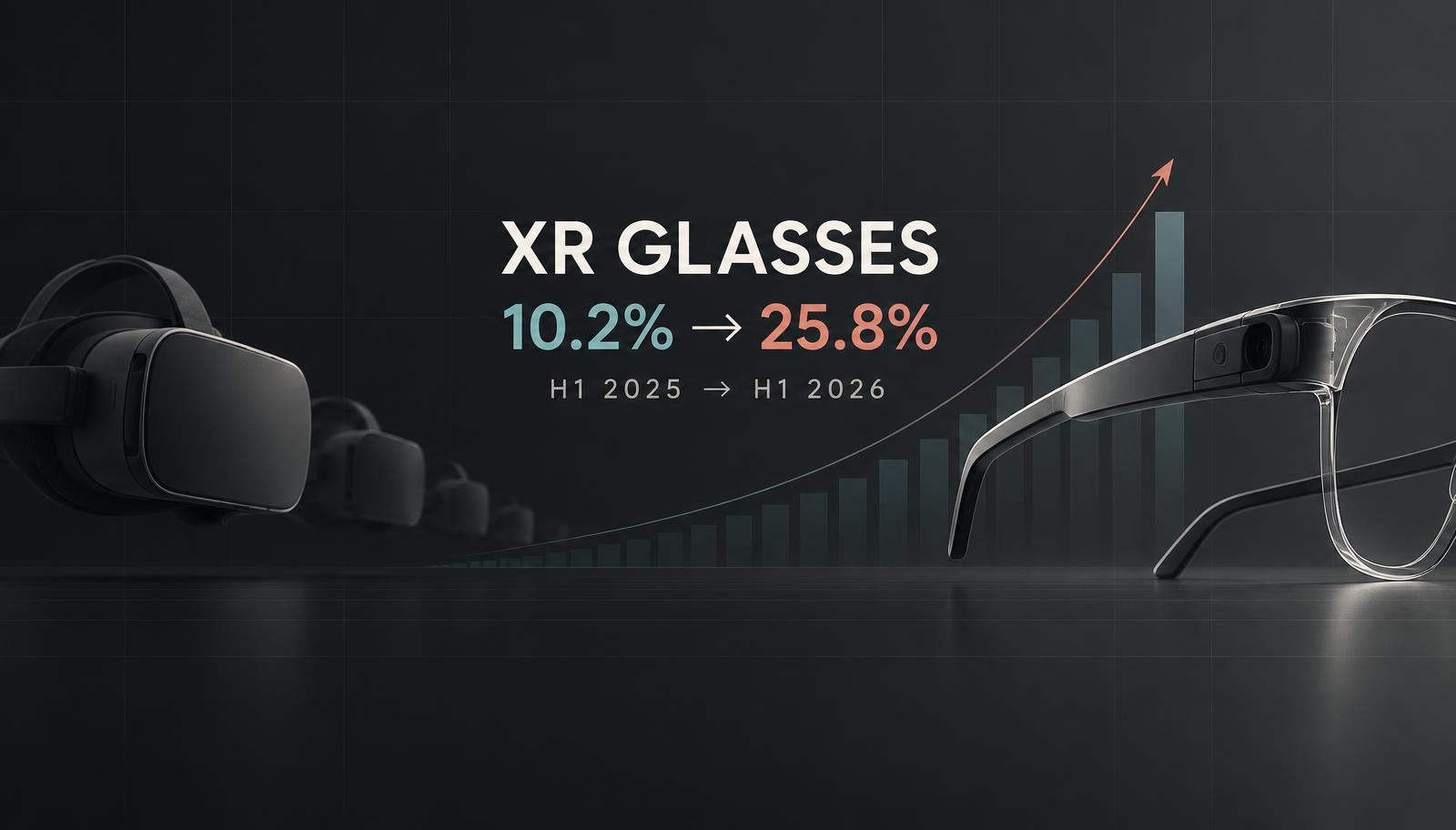
XR glasses gain ground as global headset shipments fall 38.7% in the first half of 2026
New Omdia data shows a major shift inside the XR hardware market. Global XR headwear shipments fell 38.7% year over year in the first half of 2026, but XR glasses more than doubled their share of the category as consumers increasingly favor lighter, lower-friction devices.
RayNeo GT Max and iO debut at IFA 2026: two different paths for the future of AR glasses
RayNeo has brought two very different approaches to wearable spatial computing to IFA 2026. The GT Max focuses on cinematic AR with a 59° field of view and Dolby Vision, while the 33-gram iO explores lightweight, camera-free AI assistance for everyday use.
Google AgentHands gives AI agents spatial hand gestures in XR
Google Research has introduced AgentHands, an LLM-powered XR prototype that gives AI assistants synchronized virtual hands able to point, demonstrate actions and interact with objects in physical space.