XR glasses gain ground as global headset shipments fall 38.7% in the first half of 2026
New Omdia data shows a major shift inside the XR hardware market. Global XR headwear shipments fell 38.7% year over year in the first half of 2026, but XR glasses more than doubled their share of the category as consumers increasingly favor lighter, lower-friction devices.
Key takeaways
- Global XR headwear shipments fell 38.7% year over year in the first half of 2026, to 1.9 million units, according to Omdia.
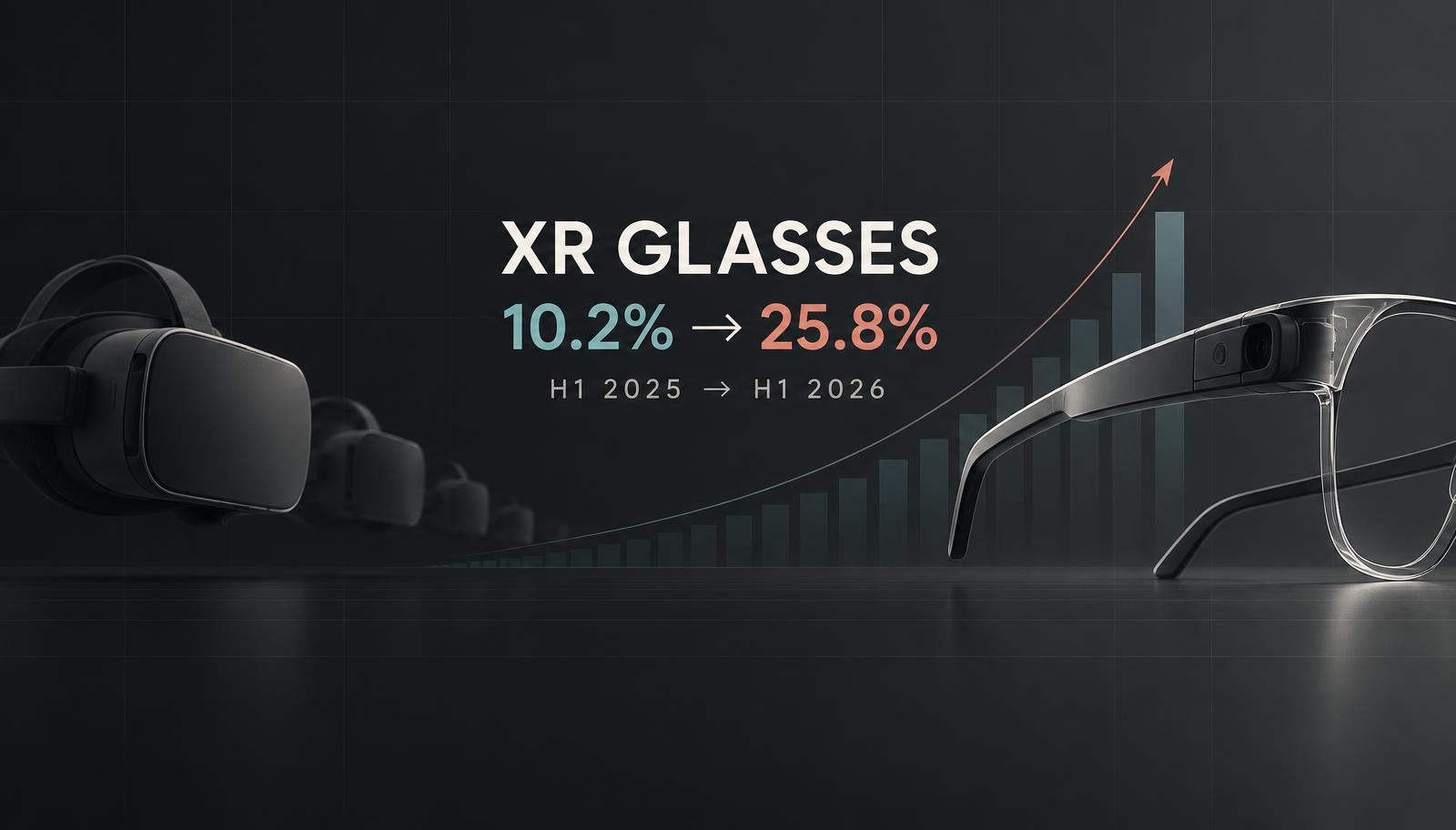
- XR glasses grew from 10.2% to 25.8% of all XR headwear shipments in the same period.
- Growth is concentrated in lightweight tethered display glasses rather than fully immersive headsets.
- The category is not simply contracting: demand is shifting toward lower-friction, everyday wearable form factors.
The XR market is shrinking, but the numbers reveal a deeper transition
The global XR hardware market entered 2026 with a contradiction: fewer XR devices are shipping overall, yet glasses are taking a rapidly growing share of the market.
According to new data published by Omdia, global XR headwear shipments reached 1.9 million units during the first half of 2026, a 38.7% year-over-year decline.
At first glance, that suggests a difficult period for XR. But the composition of those shipments tells a more interesting story.
XR glasses represented 25.8% of total XR headwear shipments in H1 2026, compared with just 10.2% one year earlier. The market is therefore not simply contracting. It is changing form.
Consumers are trading immersion for lower friction
Most of the growth came from tethered display glasses: lightweight devices that connect to a phone, computer or other processing source and primarily provide a large virtual display.
RayNeo, VITURE and XREAL collectively captured 93.1% of this segment during the first half of the year. Strong demand also pushed RayNeo and VITURE into second and third place respectively across the entire XR headwear market, with shares of 9.9% and 8.6%.
The reason behind the shift may be less about technological capability and more about friction. Traditional VR and MR headsets offer significantly deeper immersion, tracking and spatial interaction, but require users to accept additional weight, isolation and setup.
Display glasses offer less immersion, but they are lighter and address familiar activities such as watching video, gaming or using a portable virtual screen. Omdia describes this as consumers becoming increasingly willing to exchange some immersion for easier everyday use.
Meta remains number one, but its share has fallen sharply
The transition is also changing the competitive structure of XR hardware. Meta remains the largest XR headwear vendor globally, but Omdia estimates its market share declined from 71.3% in H1 2025 to 48.2% in H1 2026.
Weakening demand for Quest 3 and Quest 3S contributed to the decline. This does not mean that VR is disappearing: headsets remain the more capable format for high-immersion gaming, simulation, training and advanced spatial applications.
It does indicate that better specifications alone have not generated another consumer upgrade cycle comparable to Quest 2. The market is increasingly testing another proposition: whether XR can become more frequent by becoming less intrusive.
The geographical map is changing too
North America remained the largest XR headwear market in the first half of 2026, representing 43.9% of global shipments. Western Europe followed with 23.8%.
Greater China increased its global share from 11.9% in 2025 to 16.3% in H1 2026, overtaking the rest of Asia-Pacific as the third-largest regional market. Omdia attributes much of that growth to domestic demand for tethered XR glasses.
That matters because several of the strongest companies in this emerging category—including RayNeo and XREAL—have substantial roots in the Chinese hardware ecosystem.
A second dataset reinforces the glasses trend
Omdia's numbers cover XR headwear, but recent data from International Data Corporation points toward the same broader transition. IDC reported that display-less smart glasses grew 167% year over year in Q1 2026, reaching approximately 2.25 million units in a single quarter.
IDC forecasts approximately 13.6 million display-less smart glasses shipments for full-year 2026, rising to 27.3 million by 2030.
These products are technically different from the tethered display glasses measured within Omdia's XR category. But together, the two datasets expose the same direction of travel: the eyewear form factor is gaining importance across multiple branches of spatial and wearable computing.
‘XR glasses’ is becoming several different markets
This shift also makes the term ‘XR glasses’ increasingly insufficient. The market is separating into several hardware models.
- Display glasses prioritize virtual screens, entertainment and gaming.
- AI smart glasses prioritize cameras, microphones, voice interaction and contextual AI, sometimes without a display.
- AR and spatial computing glasses are adding displays, environmental understanding, tracking and spatial interfaces.
- VR/MR headsets continue to prioritize immersion and richer spatial interaction.
These categories are unlikely to converge immediately. Instead, the current hardware landscape suggests that different levels of immersion, weight, compute and sensing will coexist.
The important metric may become frequency of use
Historically, XR hardware has often competed on field of view, resolution, tracking quality and graphical capability. Those metrics remain important, but the growth of glasses introduces another variable: how easily the device fits into a user's existing behavior.
A headset capable of a highly immersive two-hour experience and glasses that can be worn repeatedly throughout the day solve fundamentally different problems. This distinction becomes even more important as AI enters wearable computing.
Omdia expects AI agents to become another potential driver for XR glasses, turning eyewear into a visual interface for everyday computing rather than only a device for immersive sessions.
The first half of 2026 therefore presents a more nuanced picture than the headline 38.7% decline suggests. XR hardware is under pressure, but within that contraction, lighter glasses are gaining share quickly.
"The next phase of spatial computing may depend not only on making digital experiences more immersive, but on making access to them easier, lighter and frequent enough to become part of everyday behavior."
Sources
- Omdia — Global XR headwear shipments fall 39% in 1H26 as XR glasses growth fails to offset headset decline (September 3, 2026)
- IDC — Smart Glasses Surge: The XR Market Is Rewriting Its Own Rules (2026 market data and forecasts through 2030)
- Telco Magazine — Omdia: XR Shipments Decline 38.7%, Meta’s Dominance Wanes (September 7, 2026)
Editorial coverage of industry news and developments across spatial computing and immersive technologies. Every story is reviewed by a second editor, and hardware claims are checked against manufacturer documentation before publication.
Related reading
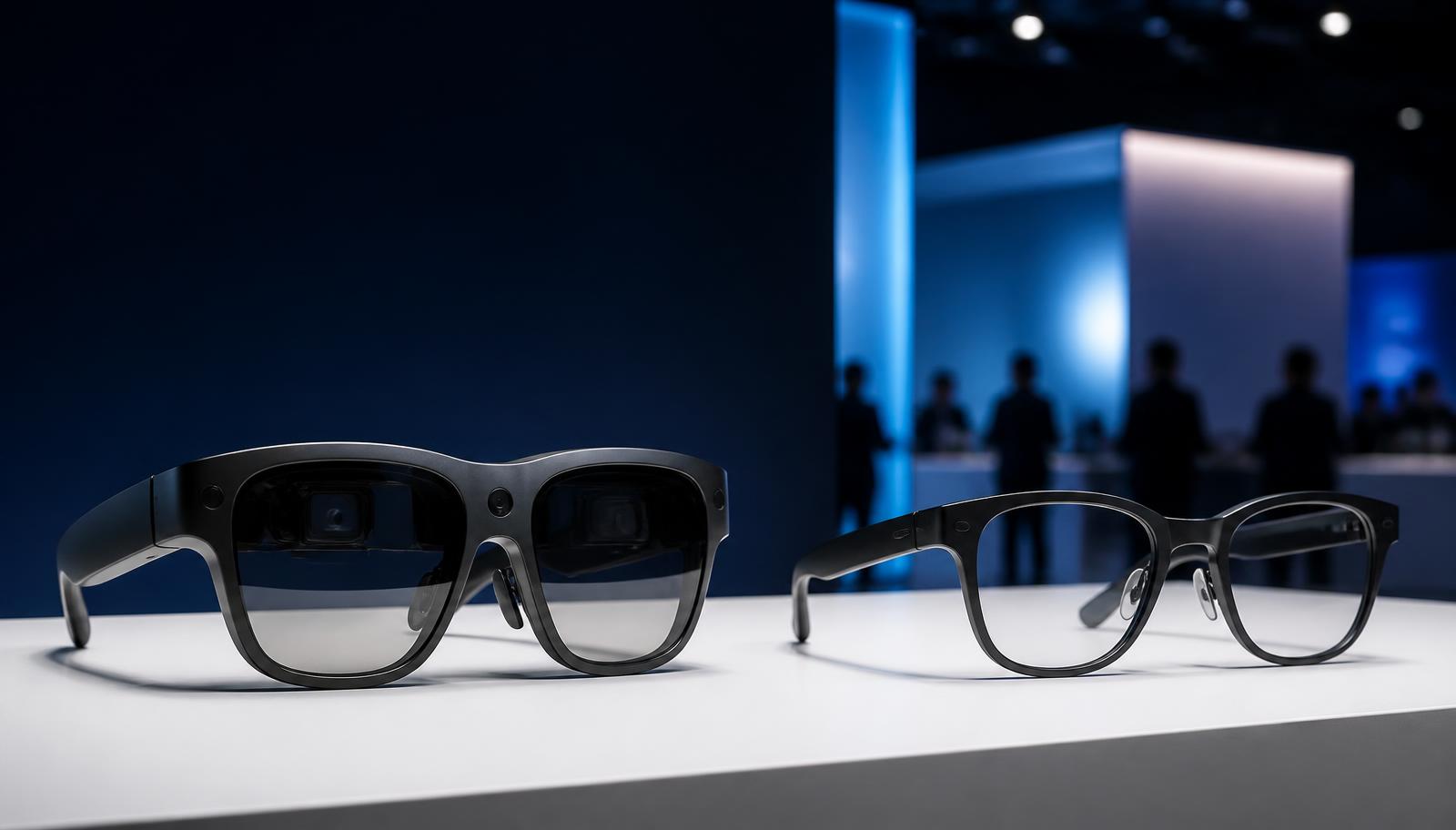
RayNeo GT Max and iO debut at IFA 2026: two different paths for the future of AR glasses
RayNeo has brought two very different approaches to wearable spatial computing to IFA 2026. The GT Max focuses on cinematic AR with a 59° field of view and Dolby Vision, while the 33-gram iO explores lightweight, camera-free AI assistance for everyday use.
Google AgentHands gives AI agents spatial hand gestures in XR
Google Research has introduced AgentHands, an LLM-powered XR prototype that gives AI assistants synchronized virtual hands able to point, demonstrate actions and interact with objects in physical space.
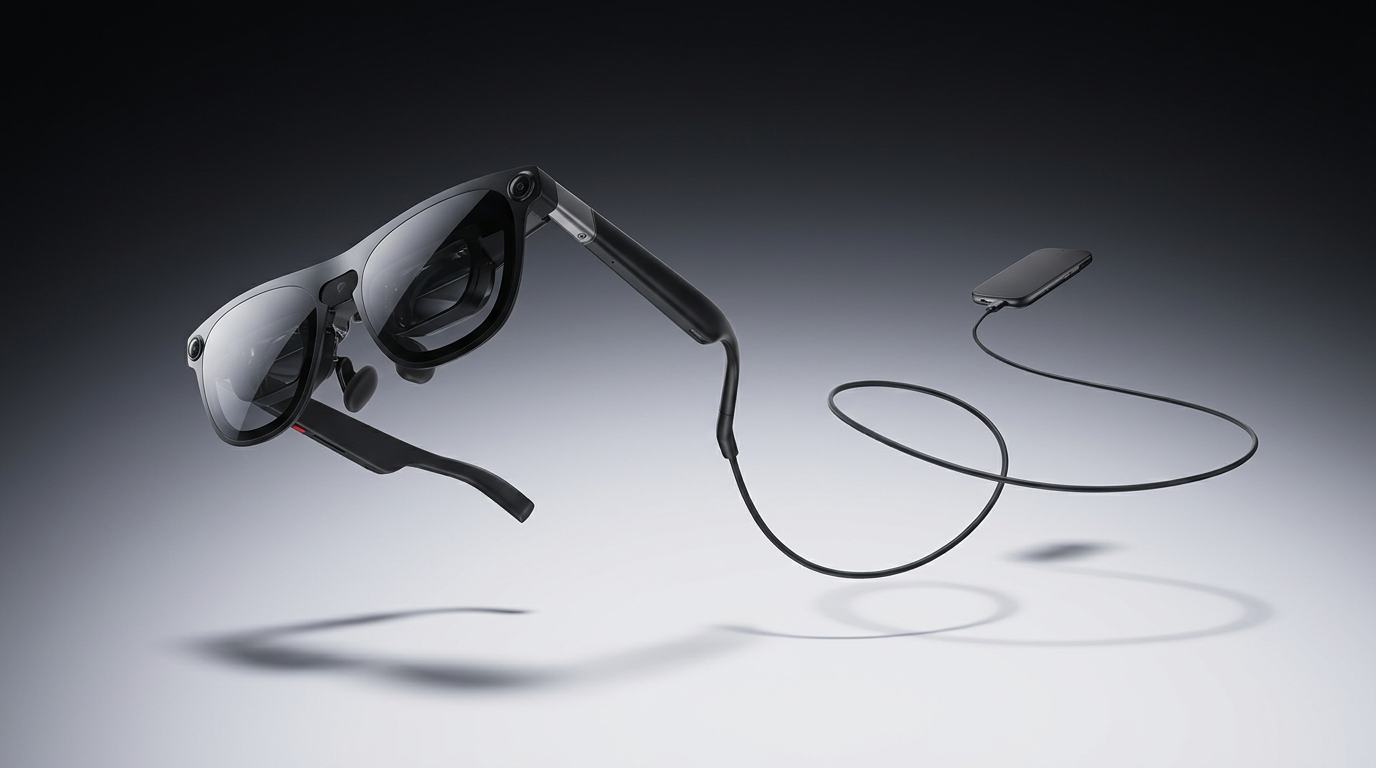
XREAL AURA passes 10,000 reservations before launch: Android XR gains traction in spatial computing
XREAL AURA has passed 10,000 global reservations before reaching the market. The spatial computing glasses pair Android XR, Google Gemini, a 70° field of view and a separate compute puck, signalling early demand for lighter XR devices.