Pimax Crystal Pro introduces eye-tracked wireless streaming without video compression in the focus area
Pimax unveils Crystal Pro, a wireless VR headset featuring eye-tracked 60GHz streaming, 2880 × 2880 displays per eye and an optional 6Gbps AirLink system.
Key takeaways
- Native Foveated Streaming uses eye tracking to send the GPU's native image, without video compression, in the user's focal region.
- The optional third-generation 60G AirLink uses two 2×2 MIMO antennas for up to 6Gbps and under 2 ms of added transmission latency.
- Crystal Pro pairs 2880 × 2880 QD-LCD panels per eye with aspheric glass lenses, 35 PPD and Mini-LED local dimming.
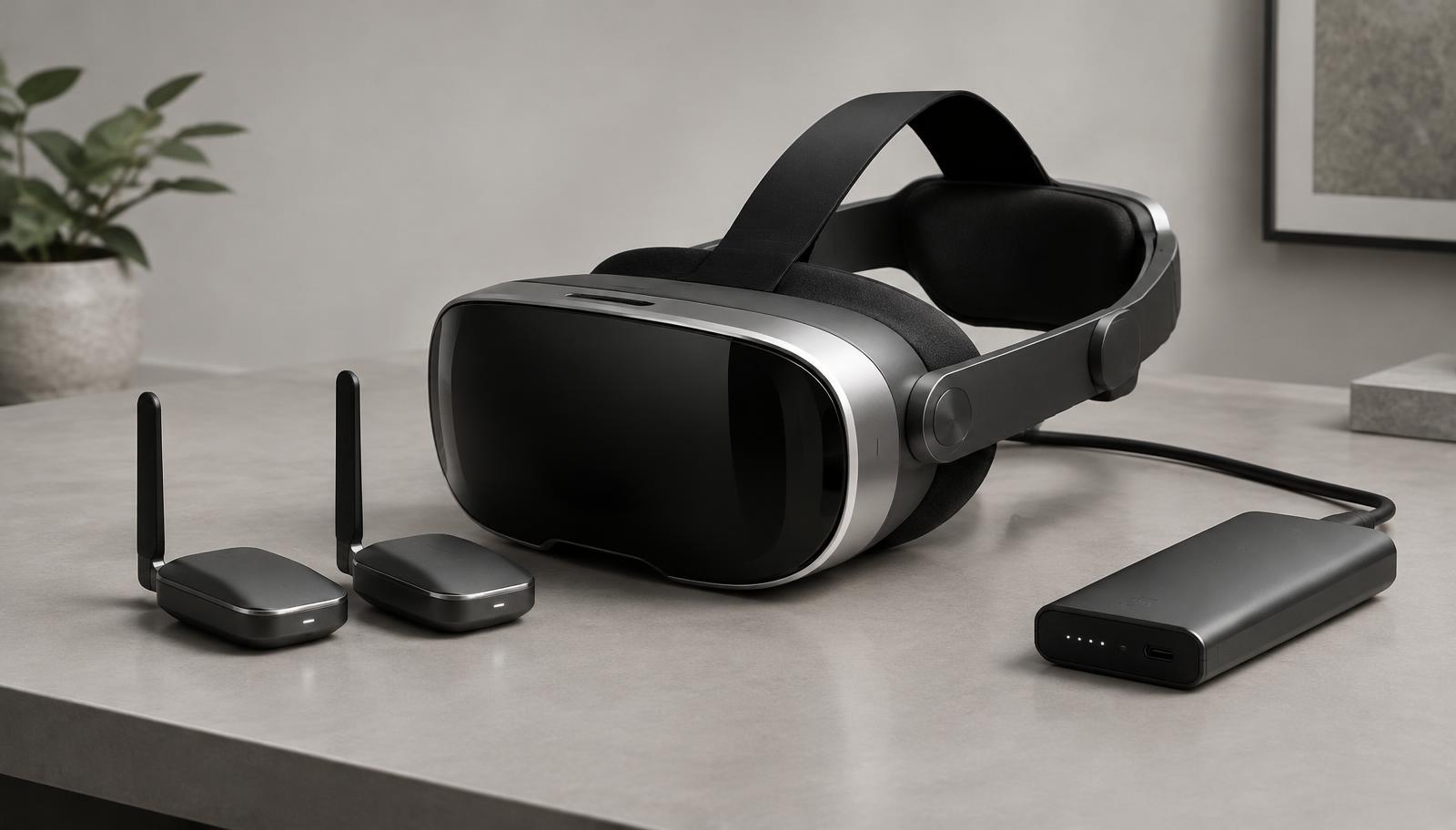
- A 16,000mAh external battery moves weight off the head; standalone mode runs on Snapdragon XR2 Gen 1.
- Prices: $1,399 headset, $1,899 with AirLink, $599 AirLink kit; shipments expected in 2027.
Wireless VR still has an image quality problem
Wireless virtual reality has improved significantly over the past several years. Modern headsets can stream demanding PC VR experiences over Wi-Fi, allowing users to move without a physical connection to their computer. However, wireless streaming introduces a familiar compromise.
High-resolution images must be compressed before transmission, then decoded by the headset. Depending on the connection, rendering workload and compression method, this process can introduce visual artifacts, reduced image clarity and additional latency. On October 6, 2026, Pimax announced a new approach to this problem.
Its latest headset, Pimax Crystal Pro, introduces a technology called Native Foveated Streaming, designed to transmit the GPU's native image without conventional video compression in the region where the user is looking. The system combines eye tracking, a dedicated 60GHz wireless connection and a new transmission architecture. Pimax presented the headset during its Frontier 2026 event, alongside new VR controllers and a compact PC designed for high-performance virtual reality.
What makes Native Foveated Streaming different?
Conventional wireless VR systems typically compress the rendered image into a video stream. The headset receives that stream and decodes it before displaying the result. Native Foveated Streaming approaches the problem differently.
Instead of treating every part of the image equally, the system uses eye tracking to identify the region where the user is currently looking. That region receives the highest-quality image data. With the optional 60G AirLink system, Pimax says the image within the focal region can be transmitted without the video encoding and decoding required by conventional Wi-Fi streaming.
The surrounding image receives a different allocation of transmission resources. This distinction is important. Native Foveated Streaming is not the same as conventional foveated rendering.
Foveated rendering reduces the computational resources required to render peripheral regions of an image. Foveated streaming determines how image information is transmitted between the computer and headset. Crystal Pro supports both approaches.
The result is a system designed to optimize rendering and wireless transmission around the user's visual attention.
A dedicated 60GHz wireless connection
The technology depends on Pimax's third-generation 60G AirLink system. Unlike standard Wi-Fi streaming, the optional AirLink kit uses a dedicated 60GHz connection. The system includes two room antennas operating in a 2×2 MIMO configuration.
According to Pimax, this arrangement provides up to 6Gbps of combined bandwidth. The company also claims that the wireless transmission system introduces less than 2 milliseconds of additional latency. That figure refers specifically to the transmission component, not the complete motion-to-photon latency of the VR experience.
The two antennas provide separate communication paths. If one path becomes temporarily obstructed, the second may help maintain connectivity. This matters because 60GHz wireless signals require relatively clear transmission paths and do not penetrate walls effectively.
The technology therefore offers high bandwidth, but it also requires a more controlled physical environment than conventional Wi-Fi. Pimax's implementation attempts to address that limitation through multiple antennas and beam alignment.
Eye tracking becomes part of the transmission system
Crystal Pro incorporates an eye-tracking system with ten infrared emitters per eye. The system samples gaze information at 120Hz. Eye tracking is already used in several XR devices for interaction, rendering optimization and visual attention analysis.
Pimax extends its role into wireless image delivery. The headset continuously determines the user's focal region and uses that information to prioritize transmission. This creates a direct relationship between visual attention and the amount of image data sent to the headset.
For applications requiring detailed visual information, that approach could be particularly relevant. Flight simulation, racing simulation, engineering visualization and other high-resolution VR applications often contain small interface elements, distant objects and detailed environments. Compression artifacts can become more noticeable when users need to distinguish fine visual details.
Pimax is positioning Native Foveated Streaming as a way to preserve those details without returning to a permanently wired headset.
Crystal Pro hardware specifications
Beyond its wireless architecture, Crystal Pro includes several hardware improvements. The headset uses quantum-dot LCD panels with a resolution of 2880 × 2880 pixels per eye. That represents approximately 17 million pixels across both displays.
The optical system combines these panels with aspheric glass lenses. Pimax has chosen to continue using aspheric lenses rather than switching to the pancake optics adopted by several competing headsets. The company argues that this approach preserves more light transmission.
Other specifications include:
- 110-degree horizontal field of view.
- 35 pixels per degree.
- Refresh rates of 72Hz, 90Hz and 120Hz.
- Mini-LED local dimming with 576 zones per eye.
- Integrated eye tracking.
- SLAM 2.0 inside-out tracking.
- Optional Lighthouse tracking.
- Optional mixed-reality faceplate with color passthrough and LiDAR.
The displays support up to 120Hz, although Pimax specifies up to 90Hz for the uncompressed focal-region transmission mode over 60G AirLink. The headset also supports a wired DisplayPort 1.4a connection. That allows users to select between wireless convenience and a conventional direct PC connection.
The battery moves away from the headset
Another notable design decision concerns power. Crystal Pro does not integrate its main battery into the headset. Instead, it uses an external 16,000mAh battery pack.
The battery can be carried separately, reducing the amount of mass positioned directly on the user's head. Pimax has also redesigned the headset's rigid backstrap, facial interface and eye-relief adjustment. These changes reflect a broader challenge in VR hardware development.
Increasing display resolution and processing capabilities does not automatically improve the experience if the resulting headset becomes uncomfortable during extended use. Weight distribution, thermal management and physical ergonomics remain important design constraints. Crystal Pro attempts to address these factors without abandoning the high-resolution displays associated with the Crystal product family.
More than a wireless PC VR headset
Pimax also confirmed that Crystal Pro supports standalone operation. The headset includes a Snapdragon XR2 Gen 1 processor, allowing compatible applications to run without a connected PC. However, its primary positioning remains high-performance PC VR.
The company is also introducing interchangeable faceplates. These can provide additional capabilities, including Lighthouse tracking or mixed-reality functionality. This modular approach allows the headset to support different configurations rather than requiring every feature to be permanently integrated.
During Frontier 2026, Pimax also announced its Ringless VR Controllers. These controllers eliminate the traditional tracking rings used in earlier designs. They can operate as six-degrees-of-freedom VR controllers and can also be physically connected to form a conventional gamepad.
A separate product, Pimax Spation, was introduced as a compact gaming PC designed for demanding VR applications. Together, the announcements indicate that Pimax is expanding beyond individual headsets toward a more complete PC VR hardware ecosystem.
Pricing and availability
Pimax has confirmed the following prices:
- Crystal Pro: $1,399 USD
- Crystal Pro + third-generation 60G AirLink: $1,899 USD
- Third-generation 60G AirLink kit: $599 USD
The standard Crystal Pro includes Wi-Fi streaming. The 60GHz system is an optional upgrade. Pimax is accepting $1 reservations, but the headset is not yet shipping.
According to the company's Frontier 2026 FAQ, hands-on demonstrations are scheduled to begin during the fourth quarter of 2026, with commercial shipments expected in 2027. The company has not confirmed a specific delivery date.
Wireless VR is becoming more specialized
The Crystal Pro announcement illustrates how wireless VR is evolving. The objective is no longer simply to remove the cable. Manufacturers are increasingly experimenting with dedicated transmission hardware, eye tracking, rendering optimization and modular computing architectures.
Each approach introduces different trade-offs. Standard Wi-Fi offers convenience and relatively simple installation. Dedicated high-bandwidth connections can preserve more image information but may require additional equipment and careful positioning.
External batteries reduce headset weight while introducing another component users must carry. Crystal Pro combines several of these approaches into a single system. Its central proposition is that high-resolution PC VR should not necessarily require a physical video cable.
Whether Native Foveated Streaming delivers a consistently noticeable improvement will depend on independent testing once the hardware becomes available. For now, the announcement represents a technically distinct approach to one of wireless VR's longest-standing limitations: preserving image quality while allowing users to move freely.
Sources
- Pimax — Official announcement, October 6, 2026: specifications, Native Foveated Streaming architecture, 60G AirLink and additional hardware.
- Pimax — Crystal Pro product page: hardware specifications, optics, tracking and wireless connectivity.
- Pimax — Frontier 2026 FAQ: pricing, reservations, shipping expectations and configurations.
- PC Gamer — October 2026: independent coverage of the headset and Pimax hardware announcements.
Editorial coverage of industry news and developments across spatial computing and immersive technologies. Every story is reviewed by a second editor, and hardware claims are checked against manufacturer documentation before publication.
Related reading
Meta is introducing a different kind of smart glasses
Ray-Ban Meta Audio begins shipping at $349: camera-free, display-free smart glasses built around open-ear audio, voice interaction and Meta's AI assistant.

TRANCITY Nebula introduces 3D spatial change detection and new digital twin analytics tools
CalTa announces new spatial analytics capabilities for TRANCITY Nebula, including voxel-based change detection, 3D visualization, digital twins and environmental data overlays.

Google and Unity introduce Unity Spark, bringing AI-powered creation closer to interactive 3D development
Google and Unity announce Playground and Unity Spark, combining generative AI, natural language creation and Unity's real-time 3D engine to simplify interactive development.