Meta is introducing a different kind of smart glasses
Ray-Ban Meta Audio begins shipping at $349: camera-free, display-free smart glasses built around open-ear audio, voice interaction and Meta's AI assistant.
Key takeaways
- Ray-Ban Meta Audio began shipping on October 13, 2026, starting at $349, after its announcement at Meta Connect 2026.
- The glasses remove the camera and display entirely, focusing on open-ear speakers, microphones and voice interaction with Meta's AI assistant.
- At approximately 43 grams, they are Meta's lightest AI glasses to date, available in Clubmaster and Burbank styles with 23 frame and lens combinations.
- Meta claims up to 12 hours of battery life, with an additional 48 hours from the charging case.
- Removing the camera addresses a major privacy concern, though microphones and data processing still require clear controls.
The smart-glasses industry has spent years adding more capabilities to increasingly compact devices. Cameras, microphones, displays, sensors and artificial intelligence have gradually transformed conventional eyewear into wearable computers. Meta's latest product takes a different approach.
On October 13, 2026, Ray-Ban Meta Audio began shipping, introducing a new category within the company's growing smart-glasses portfolio. Unlike Ray-Ban Meta models equipped with cameras, the new glasses focus exclusively on audio interaction and AI assistance. There is no camera. There is no integrated display. Instead, the glasses combine speakers, microphones and voice interaction inside conventional Ray-Ban frames.
Starting at $349, the product is designed for people who want hands-free digital assistance without wearing a device capable of recording their surroundings. Meta originally announced the glasses during Meta Connect 2026, with commercial shipments scheduled for October 13.
Smart glasses without visual computing
Ray-Ban Meta Audio does not provide augmented-reality overlays or spatial displays. The device operates primarily through sound. Users can listen to music, make phone calls, receive spoken information and interact with Meta's AI assistant. This makes the product closer to a combination of open-ear headphones and a wearable voice interface than to conventional AR glasses.
The distinction is significant. Many emerging smart-glasses products attempt to combine visual computing, AI and continuous environmental awareness. Meta Audio removes the visual component entirely. The company is effectively separating two different product experiences: one uses cameras and potentially displays to interact with visual information; the other focuses on audio, voice and access to digital services. Both approaches can reduce the need to interact directly with a smartphone, but they provide different capabilities.
A lighter design for everyday use
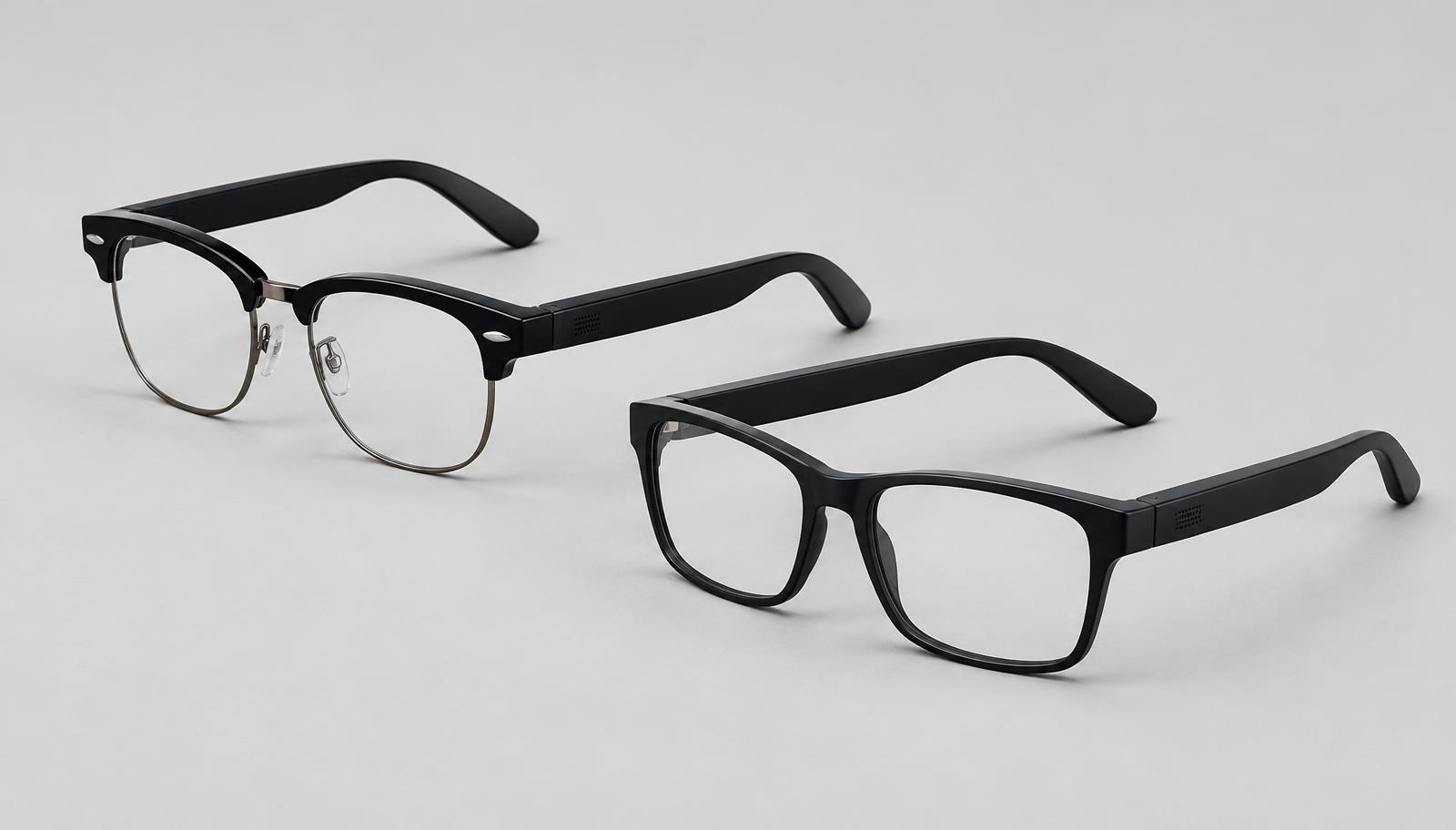
Ray-Ban Meta Audio weighs approximately 43 grams, making it Meta's lightest AI glasses design to date. The frames incorporate adjustable temple tips, interchangeable nose pads and hinges designed to accommodate different head shapes.
Meta has introduced two styles. Clubmaster follows Ray-Ban's recognizable retro-inspired design, while Burbank offers a more conventional rectangular frame. Together, they are available in 23 combinations of frames and lenses, and both styles support a broad range of optical prescriptions.
This is an important aspect of the product. For smart glasses to become everyday accessories, they need to function as actual eyewear. Users who require prescription lenses should not necessarily have to choose between vision correction and wearable technology. Meta's collaboration with EssilorLuxottica allows the company to incorporate familiar eyewear manufacturing and fitting practices into its technology products.
Audio becomes the primary interface
Meta says audio has been one of the most frequently used capabilities across its smart-glasses portfolio, and Ray-Ban Meta Audio is built around that behavior. The glasses use open-ear speakers that allow users to hear digital content while remaining aware of sounds in their surroundings — an approach that differs from traditional headphones that cover or seal the ears.
The glasses also include microphones for calls and voice commands. Through Meta's assistant, users can access certain connected services without opening applications on their phones: checking calendar information, setting reminders, asking questions and receiving spoken directions.
However, removing the camera also introduces functional limitations. The assistant cannot use the glasses to identify objects, interpret signs or answer questions based on live visual information. Those capabilities remain associated with camera-equipped smart glasses.
Battery life and everyday operation
Meta claims up to 12 hours of operation on a single charge, with an additional 48 hours available through the charging case. These figures are manufacturer estimates, and actual battery life depends on usage. The glasses are designed to support extended periods of listening, calling and voice interaction.
Independent testing published around the launch has generally highlighted their lightweight construction and battery performance. However, reviewers have also identified familiar limitations associated with open-ear audio: sound quality can deteriorate at higher volumes, audio may be audible to people nearby, and noisy environments can make listening more difficult. These are common trade-offs in audio systems that deliberately avoid sealing the ears.
Removing the camera changes the privacy discussion
One of the most notable decisions is the complete removal of image capture. Camera-equipped smart glasses have generated concerns about recording people without their knowledge: the devices can look similar to ordinary eyewear, making it difficult for bystanders to determine whether recording is taking place.
Meta Audio eliminates that particular capability. Users cannot take photographs or record videos through the glasses, which may make the product more acceptable in environments where cameras are restricted or socially uncomfortable.
However, removing the camera does not eliminate every privacy consideration. The glasses still contain microphones and connect to digital services. Voice interactions, account permissions and the processing of personal information remain relevant. The product therefore reduces one category of privacy concern without removing the need for clear controls over audio and personal data.
AI capabilities are still evolving
Ray-Ban Meta Audio launches with Meta's Muse Spark assistant, and the company has announced plans to expand its glasses ecosystem with more advanced Muse capabilities. However, those future features should not be confused with functionality already available at launch.
Early independent reviews indicate that the current assistant performs relatively well with simple tasks such as reminders, basic information requests and connected services, while more complex interactions remain less consistent. This illustrates an important distinction between the hardware and software layers of AI wearables: the physical product can remain largely unchanged while its capabilities evolve through software updates. Meta is positioning its glasses as devices that can improve over time, though the extent to which those improvements change everyday usage will depend on future releases.
A growing range of wearable computing devices
Ray-Ban Meta Audio arrives as the smart-glasses market becomes increasingly segmented. Some devices focus on immersive visual experiences. Others provide transparent displays for contextual information. Camera-equipped AI glasses combine image capture with voice assistance. Audio-only glasses prioritize communication and digital access without visual sensors.
These categories are not interchangeable. A user who needs spatial interfaces will require different hardware from someone primarily interested in listening to information or managing daily tasks. Meta's expanding portfolio reflects this diversity: rather than developing a single universal pair of smart glasses, the company is introducing devices designed around different combinations of capabilities.
Smart glasses do not always need a display
Ray-Ban Meta Audio demonstrates that wearable computing does not necessarily require visual interfaces. The product is not an augmented-reality device, but it belongs to the broader evolution of computing away from conventional screens. Its central proposition is simple: some digital interactions can happen through audio without requiring users to hold a smartphone or look at a display.
The absence of a camera also creates a different balance between functionality, physical design and privacy. At $349, the glasses remain a premium accessory, particularly when compared with conventional wireless headphones. Their commercial reception will help indicate whether consumers see sufficient value in integrating audio and AI directly into everyday eyewear. The future of smart glasses may include several distinct form factors rather than a single device attempting to provide every possible capability.
Sources
- Meta — Official announcement, September 23, 2026. Product specifications, pricing, styles, battery life and October 13 shipping date. Introducing Ray-Ban Meta Audio — Meta Newsroom.
- The Verge — October 13, 2026. Independent product review covering ergonomics, audio performance, battery life, privacy and AI capabilities.
- Tom's Guide — October 2026. Additional hands-on evaluation of the camera-free design and everyday usage.
Editorial coverage of industry news and developments across spatial computing and immersive technologies. Every story is reviewed by a second editor, and hardware claims are checked against manufacturer documentation before publication.
Related reading

TRANCITY Nebula introduces 3D spatial change detection and new digital twin analytics tools
CalTa announces new spatial analytics capabilities for TRANCITY Nebula, including voxel-based change detection, 3D visualization, digital twins and environmental data overlays.

Google and Unity introduce Unity Spark, bringing AI-powered creation closer to interactive 3D development
Google and Unity announce Playground and Unity Spark, combining generative AI, natural language creation and Unity's real-time 3D engine to simplify interactive development.
Pimax Crystal Pro introduces eye-tracked wireless streaming without video compression in the focus area
Pimax unveils Crystal Pro, a wireless VR headset featuring eye-tracked 60GHz streaming, 2880 × 2880 displays per eye and an optional 6Gbps AirLink system.