XREAL AURA starts at $1,279 as Android XR glasses move closer to market
XREAL confirms pricing and initial preorders for AURA, its Android XR glasses developed with Google and Qualcomm. Discover its features, software ecosystem and availability.
Key takeaways
- XREAL AURA starts at $1,279 (12GB/256GB), with a 16GB/512GB configuration at $1,499.
- Preorders opened October 7 for customers with a prior paid reservation; wider orders follow in the coming weeks.
- First shipments target the United States, Canada, Japan and South Korea, with more markets in 2027.
- Optical see-through glasses under 95 grams offer a 70-degree field of view, paired with a wired Snapdragon Reality Elite compute unit.
- Android XR brings Google Play apps, Gemini, up to five virtual screens and DisplayPort desktop input.
The next generation of Android XR devices is getting closer to consumers. On October 7, XREAL officially confirmed pricing and opened the first preorders for XREAL AURA, its new spatial computing glasses developed in collaboration with Google and Qualcomm.
The device starts at $1,279, with a higher-end configuration priced at $1,499. Preorders are initially available to customers who previously placed a paid reservation. XREAL expects to open orders more broadly in the coming weeks, with initial shipments planned for the United States, Canada, Japan and South Korea.
The announcement marks an important step for Android XR, Google's operating system designed for immersive devices and spatial computing.
Not conventional smart glasses
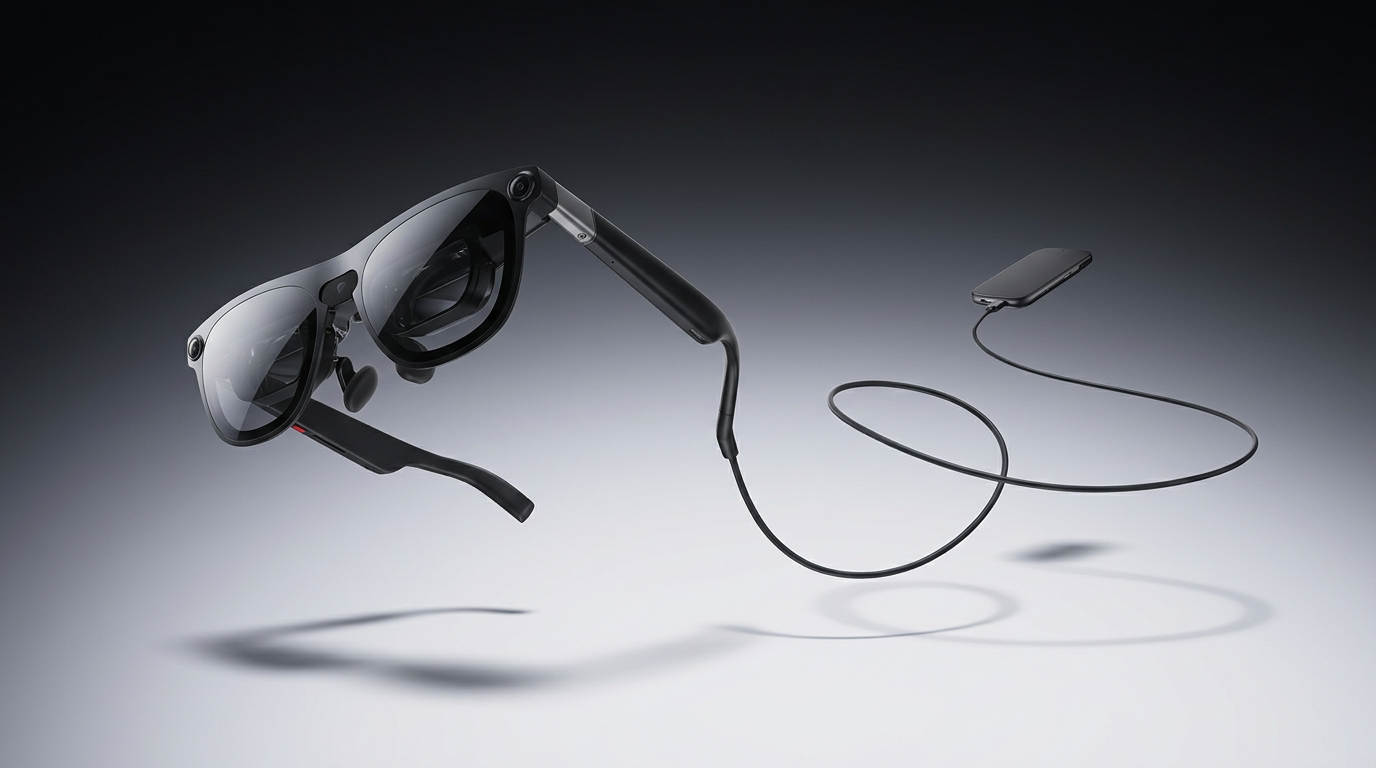
XREAL AURA belongs to a different category from the increasingly popular AI glasses that primarily rely on cameras, microphones and audio assistance. These are optical see-through XR glasses: users see their physical environment directly through transparent lenses while digital content appears within their field of view.
The glasses offer a 70-degree field of view, significantly larger than the viewing area available on many earlier AR display glasses. This allows applications to use a broader spatial canvas for interfaces, virtual screens, interactive objects and immersive experiences.
Unlike conventional VR headsets, the surrounding environment remains directly visible without requiring camera-based passthrough. The result is a device designed to combine digital content with the physical world rather than completely replace it.
The computing happens outside the glasses
One of AURA's defining characteristics is its split-compute architecture. The glasses weigh less than 95 grams, while a separate wired computing unit handles the most demanding processing tasks.
- Inside the glasses, the XREAL X1S Spatial Coprocessor manages spatial display functions and sensor processing.
- Inside the external compute unit, Qualcomm's Snapdragon Reality Elite provides the processing required for Android XR applications.
This division distributes processing workloads across two physical components and reduces the amount of hardware that needs to remain on the user's face. The external unit includes a touchpad for navigation and can be attached to clothing or carried on a lanyard. XREAL positions this architecture as a way to balance performance, portability and wearability.
Android XR brings an existing software ecosystem
AURA runs Google's Android XR platform, giving it access to the broader Android application ecosystem through Google Play — including Chrome, YouTube, Google Maps and Google Photos. XREAL also says more than 150 applications developed specifically for XR are available within its expanding ecosystem.
This creates two complementary experiences. Traditional Android applications can appear as virtual windows, while spatial applications can use tracking, hand interaction and three-dimensional content that extends into the physical environment. For developers, Android XR supports both conventional apps and experiences designed specifically for spatial computing.
A workspace without physical monitors
Productivity is a major component of AURA's positioning. The device supports up to five virtual screens that users can resize, reposition and arrange within their surroundings. AURA can also connect to a compatible computer through DisplayPort input, displaying an existing desktop within a larger virtual workspace.
Instead of requiring a fixed workstation, users can create a multi-window environment while travelling or working where additional displays are unavailable. Developers, designers, analysts and other professionals increasingly work across multiple information sources, making spatial screen management one of the more practical applications of XR.
Gemini becomes part of the spatial interface
Google Gemini is integrated into Android XR. According to XREAL, Gemini can interpret the user's current context, help navigate applications and answer questions about visible content. Outward-facing sensors support spatial tracking and AI-assisted visual understanding, subject to user permissions.
Instead of navigating every function through menus, users can combine voice, hand gestures and contextual assistance. The system supports hand tracking and six-degrees-of-freedom tracking, keeping virtual elements anchored in the environment as users move.
Two configurations and a phased launch
- 12GB RAM / 256GB storage — $1,279 USD
- 16GB RAM / 512GB storage — $1,499 USD
Both configurations use the same architecture: optical see-through glasses connected to an Android XR computing unit. The initial rollout covers the United States, Canada, Japan and South Korea, with additional markets expected during 2027. XREAL has not confirmed a specific shipping date for every region, and the current preorder window is restricted to customers who placed qualifying reservations before October 7.
Android XR is becoming a commercial platform
XREAL AURA arrives during a period of significant activity in spatial computing. Several manufacturers are exploring smaller XR devices that distribute processing, battery and display components differently — and operating systems are becoming increasingly important.
Android XR gives XREAL access to Google's application infrastructure, development ecosystem and AI capabilities. That is a different proposition from glasses that function only as external displays: AURA is designed to operate as a spatial computer with its own applications, interaction methods and software platform.
Its commercial launch will provide another opportunity to evaluate whether consumers and professionals are ready to bring spatial computing into everyday activities. XR hardware is evolving from specialized immersive equipment toward portable computing devices capable of running familiar applications alongside spatial experiences.
Sources
- XREAL — Official press release (October 7, 2026): pricing, configurations, regions and preorder conditions.
- XREAL — Official AURA product specifications: architecture, processors, displays, spatial tracking and applications.
- The Verge — XREAL AURA pricing and availability (October 7, 2026).
Editorial coverage of industry news and developments across spatial computing and immersive technologies. Every story is reviewed by a second editor, and hardware claims are checked against manufacturer documentation before publication.
Related reading
Meta is introducing a different kind of smart glasses
Ray-Ban Meta Audio begins shipping at $349: camera-free, display-free smart glasses built around open-ear audio, voice interaction and Meta's AI assistant.

TRANCITY Nebula introduces 3D spatial change detection and new digital twin analytics tools
CalTa announces new spatial analytics capabilities for TRANCITY Nebula, including voxel-based change detection, 3D visualization, digital twins and environmental data overlays.

Google and Unity introduce Unity Spark, bringing AI-powered creation closer to interactive 3D development
Google and Unity announce Playground and Unity Spark, combining generative AI, natural language creation and Unity's real-time 3D engine to simplify interactive development.